
Species Details
- Species name
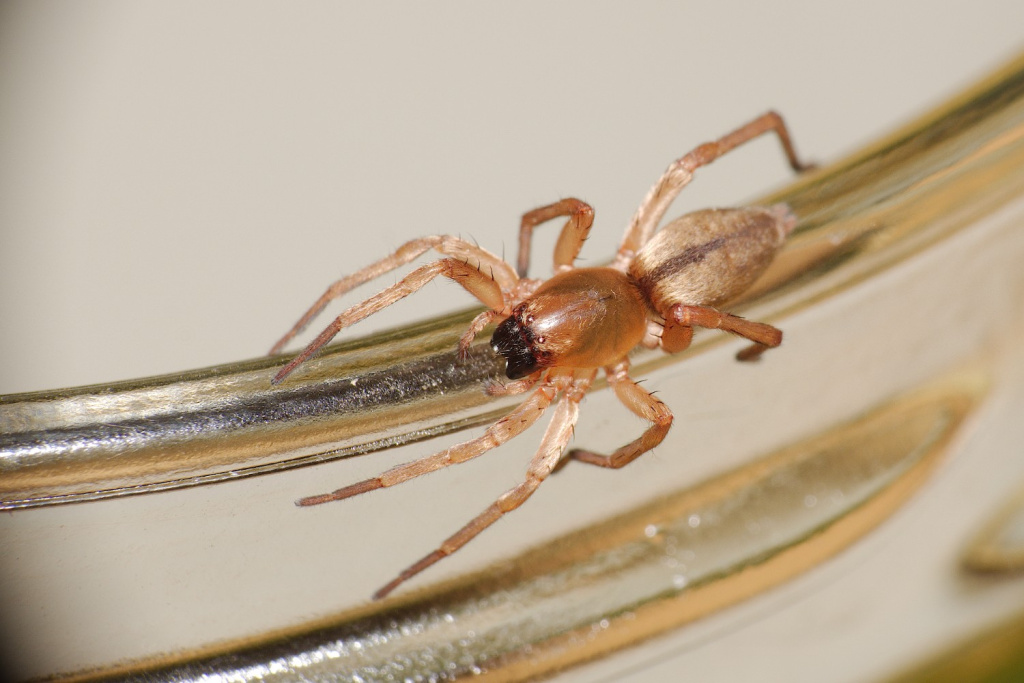
- Clubiona subsultans Thorell, 1875
- Synonym
- Clubiona erratica C.L. Koch, 1836
- Taxonomy
- Animalia :: Araneae :: Clubionidae
- decaying wood
Distribution
The species has been recorded in East Inverness-shire from Abernethy Forest since 1945, and appears to be widespread and common there, and from Rothiemurchus Forest in 1979 and 2002. There have been sporadic reports from the Black Wood of Rannoch, Mid Perthshire between 1913 and 1987. More recently there have been several records to the north and west of the previously known range, including Glen Affric, suggesting it might be more widely distributed in Scotland than previously thought. This species is widespread in Europe, being known from Italy, France, Belgium, the Netherlands, Germany, Austria, Switzerland, Denmark, Sweden, Norway, Finland, Poland, Hungary, the former Czechoslovakia and Russia.Habitat and ecology
Native pine forest. The spider is associated with Caledonian pine woods, having been found under bark, on branches, in pine litter, among young pines, and on juniper growing as an under-storey within a pine wood. Recently it has been found to be the commonest spider in artificial ‘nestbox’ traps put out in Abernethy Forest to survey for Osmia uncinata, a rare species of bee. Adults of both sexes have been found in June, males also in September.Status
Occurring in nine 10-km squares, eight since 1992. Restricted range but no decline.Threats
The loss of Caledonian native pine forest through conversion to intensive plantation forestry. Both Abernethy Forest and the Black Wood of Rannoch have suffered from planting of Scots pine and non-native conifers in large blocks, sometimes preceded by clear-felling of the native pine. However, Abernethy Forest is now owned and managed by the RSPB, and the restoration of native forest is a key aim.Management and conservation
Management should be aimed at conserving the pine and other native trees. Natural regeneration of Scots Pine should be allowed to proceed to give the typical open forest structure. Where regeneration is so dense as to be too impenetrable, early thinning of the saplings may be needed to create glades. The primary aim of the RSPB at Abernethy is to develop a self-sustaining native pine forest over the whole potential woodland area. Text based on Dawson, I.K., Harvey, P.R., Merrett, P. & Russell-Smith, A.R. (in prep.).Stats
- First recorded
- 1913
- Last recorded
- 2023
- Total records
- 68
- Total visits
- 65
Conservation status
Clubiona subsultans
| Source | Reporting category | Designation | Date designated | Comments |
|---|---|---|---|---|
| A Review of the scarce and threatened spiders (Araneae) of Great Britain: Species Status No. 22 (Sep 2017) | Rare and scarce species | Nationally Rare. Includes Red Listed taxa | 01/09/2017 | |
| A Review of the scarce and threatened spiders (Araneae) of Great Britain: Species Status No. 22 (Sep 2017) | Red listing based on 2001 IUCN guidelines | Near Threatened | 01/09/2017 | A rare pinewood species found in only eight hectads since 1993. However there has been some increase in AOO and evidence from bark trapping and unpublished surveys of semi-natural plantations show that this species is more widespread, and less dependent than formerly thought, on the core Caledonian pine areas. However, it remains at risk from the effects of climate change and catastrophic damage to its habitat, for example by fire and recently introduced tree diseases. Threats: Previously under threat from the loss of Caledonian native pine forest through conversion to intensive plantation forestry, but such a threat can be considered to have reduced or ceased. Both Abernethy Forest and the Black Wood of Rannoch have suffered from planting of Scots pine and non-native conifers in large blocks, sometimes preceded by clear-felling of the native pine. However, Abernethy Forest is now owned and managed by the RSPB, and the restoration of native forest is a key aim. |
| Scottish Biodiversity List (incorporating 2007 updates and 2012 categorisation) | Biodiversity Lists - Scotland | Scottish Biodiversity List | 29/11/2005 | Terrestrial/Freshwater Species. |
Photos and media
__