
Species Details
- Species name
- Uloborus walckenaerius Latreille, 1806
- Synonyms
- Uloborus lineata, Uloborus walckenaerii
- Taxonomy
- Animalia :: Araneae :: Uloboridae
- tall sward & scrub
Distribution
The spider has been found at a few heathland localities in southern England - the New Forest and Crookham in Hampshire; Chobham Common, Thursley Common and Ash Ranges, Surrey and Lavington Common and Ambersham Common, West Sussex (Merrett, in Bratton 1991). Denton (1999a) adds other Surrey locations for the spider at Brentmoor Common and Witley Common. It is widespread in western Europe but absent from Scandinavia and Ireland.Habitat and ecology
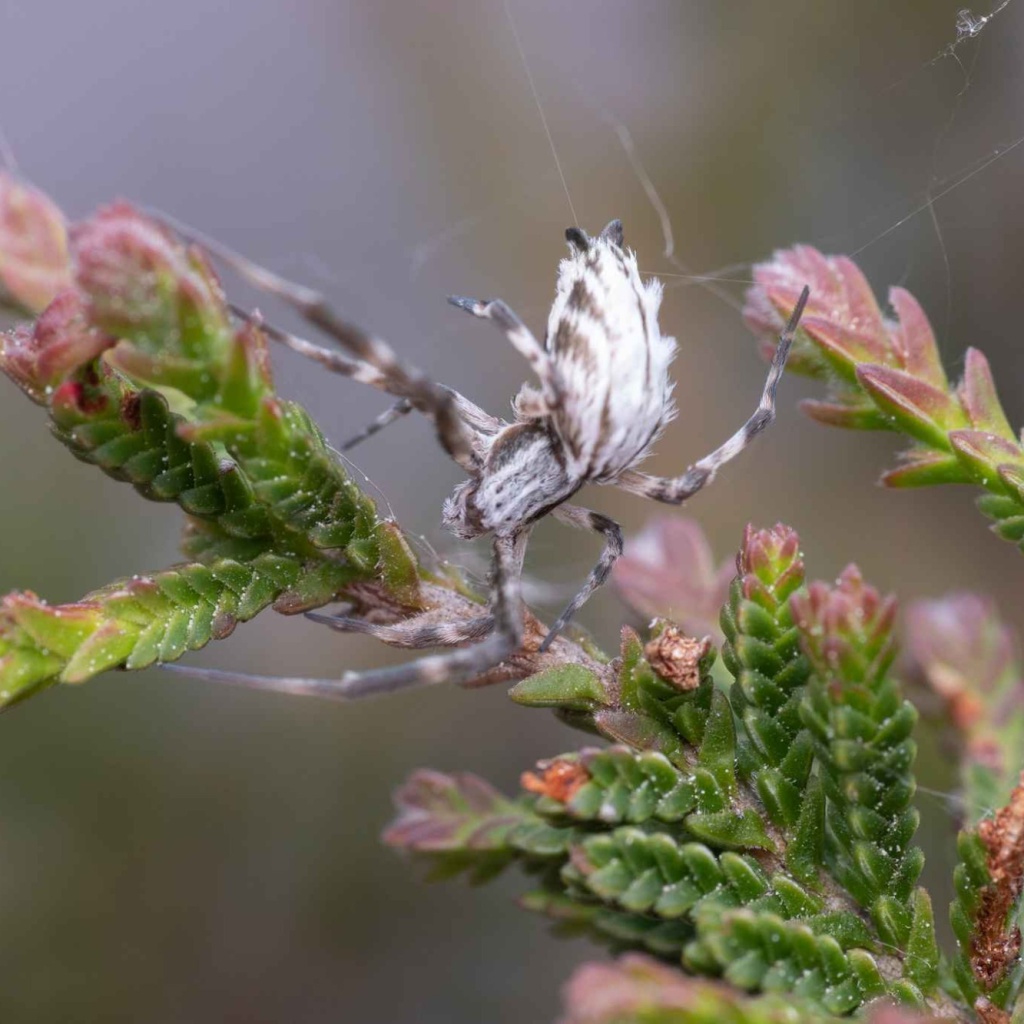
The spider favours mature heather plants where it spins a horizontal orb web about half way up the plant. There is a stabilimentum (band of silk) running through the web's hub, extending to its opposing edges. The spider hangs down from the web hub in line with the stabilimentum. Both sexes mature in the late spring.Status
UK Biodiversity Action Plan species. Large numbers have been found in some localities but the species is no longer present or severely reduced in numbers at some of its former strongholds.Threats
The prolonged and continued loss of mature heathland has destroyed much of the habitat for this species. The loss of habitat has been due primarily to fire, planting with coniferous woodland, motorcycle scrambling and birch and pine invasion (Merrett, in Bratton 1991). Housing developments have also destroyed much heathland.Management and conservation
At sites where the species still exists a mature heather habitat should be retained and encouraged. Where heather is perhaps over-mature a programme of controlled annual burning of small areas over a period of 20 years or so (Merrett, in Bratton 1991) and manual scrub clearance should help maintain a mature heather habitat. On some fenced sites the Calluna heath can be effectively managed by grazing, but this option is not possible on sites with common rights where fencing is prohibited. Text based on Dawson, I.K., Harvey, P.R., Merrett, P. & Russell-Smith, A.R. (in prep.).Stats
- First recorded
- 1800
- Last recorded
- 2024
- Total records
- 154
- Total visits
- 151
Conservation status
Uloborus walckenaerius
| Source | Reporting category | Designation | Date designated | Comments |
|---|---|---|---|---|
| A Review of the scarce and threatened spiders (Araneae) of Great Britain: Species Status No. 22 (Sep 2017) | Rare and scarce species | Nationally Rare. Includes Red Listed taxa | 42979 | |
| A Review of the scarce and threatened spiders (Araneae) of Great Britain: Species Status No. 22 (Sep 2017) | Red listing based on 2001 IUCN guidelines | Near Threatened | 42979 | The species is no longer present, or is severely reduced in numbers, at some of its former strongholds. While it qualifies for EN, it is not considered significantly threatened at its remaining, protected, sites. Threats: The prolonged and continued loss of mature heathland has destroyed much of the habitat for this species. The loss of habitat has been due primarily to fire, planting with coniferous woodland, motorcycle scrambling and birch and pine invasion (Merrett, in Bratton 1991). Housing developments have also destroyed much heathland. |
Photos and media
Spatial distribution - hectad map
Click on one of the date ranges in the key to highlight that particular range. Click anywhere else on the map to go back to all three date ranges.
Thresholds:
Move mouse cursor over dot for info
Rejected records are excluded from this map. Unverified records are included.
Temporal distribution - records by year
Records that span more than one year are not included in this chart.
Temporal distribution - records by week
__