
Species Details
- Species name
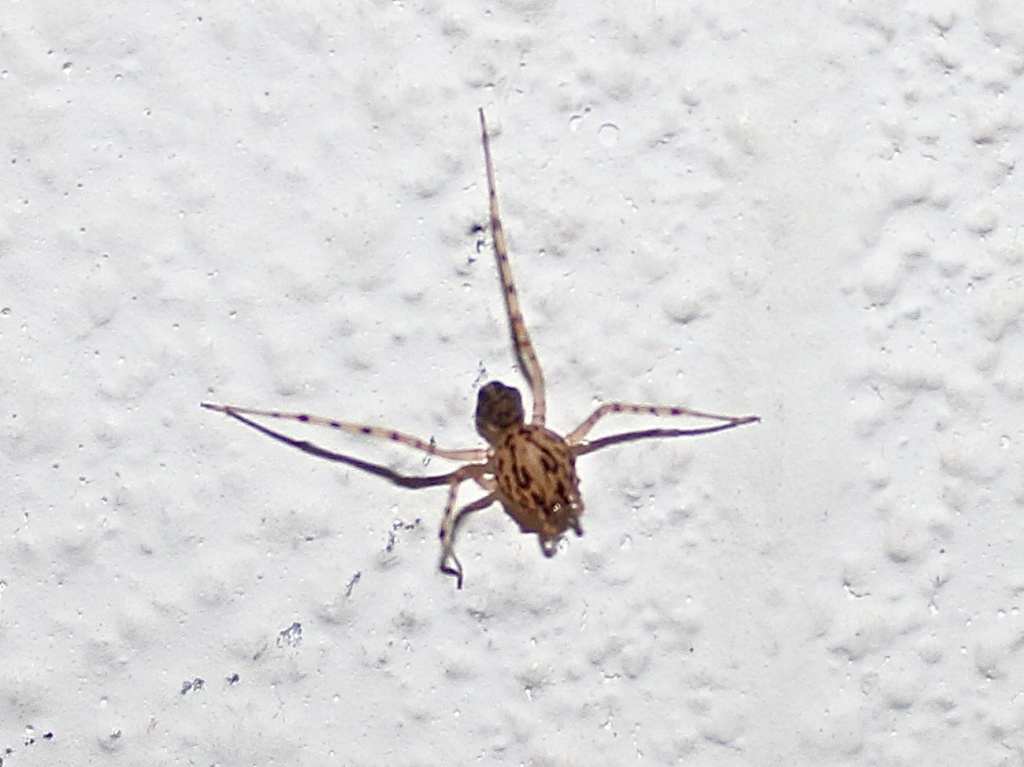
- Scytodes thoracica
- Common name
- Spitting Spider
- Taxonomy
- Animalia :: Araneae :: Scytodidae
Distribution
The species is widespread in Britain south of a line between the Humber and Glamorgan, but very rare further north and absent from Scotland. It is widespread in western and central Europe as far north as Denmark.Habitat and ecology
This slow moving species acquired the common name of spitting spider from its method of capturing prey. A sticky substance is squirted from the chelicerae in an oscillating movement onto the prey from a distance of as much as 10 mm or more, sticking it to the surface before it is despatched with a bite on the leg and removed from the gum before consumption. The squirting of gum is also used as a defensive measure against other spiders. Scytodes thoracica is limited within Britain to houses and other heated buildings where it may take as long as two or three years for the female to reach maturity. Adults can probably be found throughout the year though our very limited phenology data suggest a peak in July.Status
Synanthropic Original author of profile: R. Ruffell Text based on Harvey, P.R., Nellist, D.R. & Telfer, M.G. (eds) 2002. Provisional atlas of British spiders (Arachnida, Araneae), Volumes 1 & 2. Huntingdon: Biological Records Centre.Stats
- First recorded
- 1900
- Last recorded
- 2026
- Total records
- 440
- Total visits
- 439
Conservation status
Scytodes thoracica
| Source | Reporting category | Designation | Date designated | Comments |
|---|---|---|---|---|
| A Review of the scarce and threatened spiders (Araneae) of Great Britain: Species Status No. 22 (Sep 2017) | Red listing based on 2001 IUCN guidelines | Least concern | 42979 | A synanthropic species. |
Photos and media



















Spatial distribution - hectad map
Click on one of the date ranges in the key to highlight that particular range. Click anywhere else on the map to go back to all three date ranges.
Thresholds:
Move mouse cursor over dot for info
Rejected records are excluded from this map. Unverified records are included.
Temporal distribution - records by year
Records that span more than one year are not included in this chart.
Temporal distribution - records by week
__